




Battery Energy Storage System Explosion-Proof Valve: The Last Line of Defense for Battery Safety
INDUSTRY INSIGHT
Battery Energy Storage System Explosion-Proof Valve:
The Last Line of Defense for Battery Safety
I. Introduction: The Necessity of Explosion-Proof Valves and the Industry Context
The rapid development of the new energy vehicle industry has put an unprecedented high demand on the safety of the power battery system.
According to industry statistics, the installed capacity of power batteries in China is expected to exceed 800GWh in 2026, and the shipment of energy storage batteries is expected to exceed 300GWh, which will drive the rapid growth of the market for protective components of battery packs. Among many safety protection measures, the explosion prevention valve (also known as the pressure leak valve) is a passive safety protection core component of the battery system to prevent the loss of heat control, and its performance is directly related to the thermal safety management, service life and vehicle safety level.
During charging and discharging, lithium batteries may trigger heat loss due to overcharge, short circuit, high temperature, mechanical damage and other factors. When the heat is out of control, the reactions such as the decomposition of electrolyte and the oxidation of electrode materials will release a large amount of gas, causing the internal pressure of the battery pack to climb sharply in a few seconds. If the pressure cannot be released in time, lightly it will lead to deformation of the battery pack shell and failure of the seal, and heavily it will cause catastrophic consequences such as explosion or fire.
Core Contradiction
- The battery package box needs to be sealed to achieve waterproof and dustproof (IP67 and above).
- The sealed box faces the risk of excessive internal and external pressure difference when the temperature changes and thermal runaway.
- The explosion prevention valve is a key component in resolving this contradiction — it keeps the chamber sealed and balances the internal and external air pressure during normal operation, and quickly releases pressure when heat is out of control to prevent the chamber from bursting.
GB 38031-2025 Power battery safety requirements for electric vehicles has raised the power battery safety standard from "escape-level bottom line safety" to "risk-free essential safety" level, and added extreme safety test projects such as bottom impact test and fast charging cycle safety test. These regulatory upgrades put more stringent requirements on the response speed, pressure leakability, and reliability of explosion prevention valves.
II. Working Principle of the Explosion-Proof Valve: From Pressure Equilibrium to Directional Pressure Relief
2.1 Basic Functions and Core Structure
The explosion-proof valve performs two core functions within the battery pack system:
Function 1
Daily Pressure Balancing (Breathing Function)
During operation, the internal temperature of the battery pack continuously changes due to factors such as charging and discharging, and environmental temperature variations. According to the ideal gas state equation PV = nRT, temperature changes result in changes to the gas pressure within the sealed box. The e-PTFE (expanded polytetrafluoroethylene) micro-perforated permeable membrane integrated into the explosion-proof valve allows gas to pass freely, achieving dynamic pressure balance between the inside and outside, while preventing liquid water and dust from entering and maintaining a dry environment within the box.
Function 2
Thermal Runaway Directed Pressure Relief (Explosion-Proof Function)
When a cell undergoes thermal runaway and the internal pressure rises sharply to a predetermined threshold, the pressure relief mechanism of the explosion-proof valve is triggered — the diaphragm ruptures or the spring piston opens, creating a large area for pressure relief. This directs the high-temperature, high-pressure gas out of the box, preventing the shell from rupturing or exploding due to excessive pressure.
2.2 Comparison of the Two Main Types of Explosion-Proof Valves
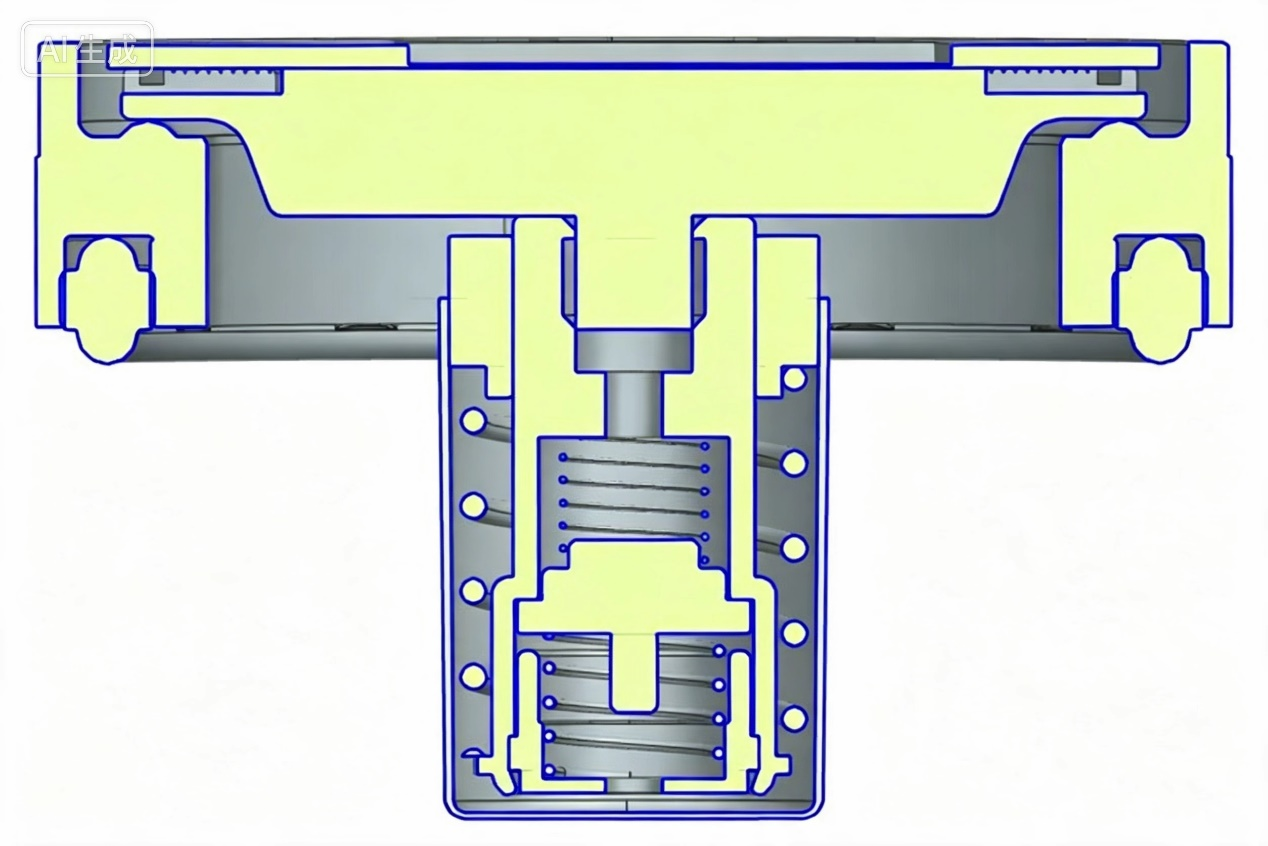
The current mainstream explosion-proof valves on the market can be categorized into three main types: spring-type, needle-type, and umbrella-type. There are significant differences in their working principles and applicable scenarios. In normal operation, the gas inside and outside the battery pack casing flows freely through the waterproof and breathable membrane embedded within the valve, achieving pressure equilibrium between the inside and outside. When the internal pressure exceeds the set threshold, the gas pressure pushes the internal spring piston rod open, allowing for rapid discharge and pressure relief. Once the internal pressure decreases, the spring actuates the piston to return to its original position, closing the pressure relief channel, and restoring normal sealing conditions.
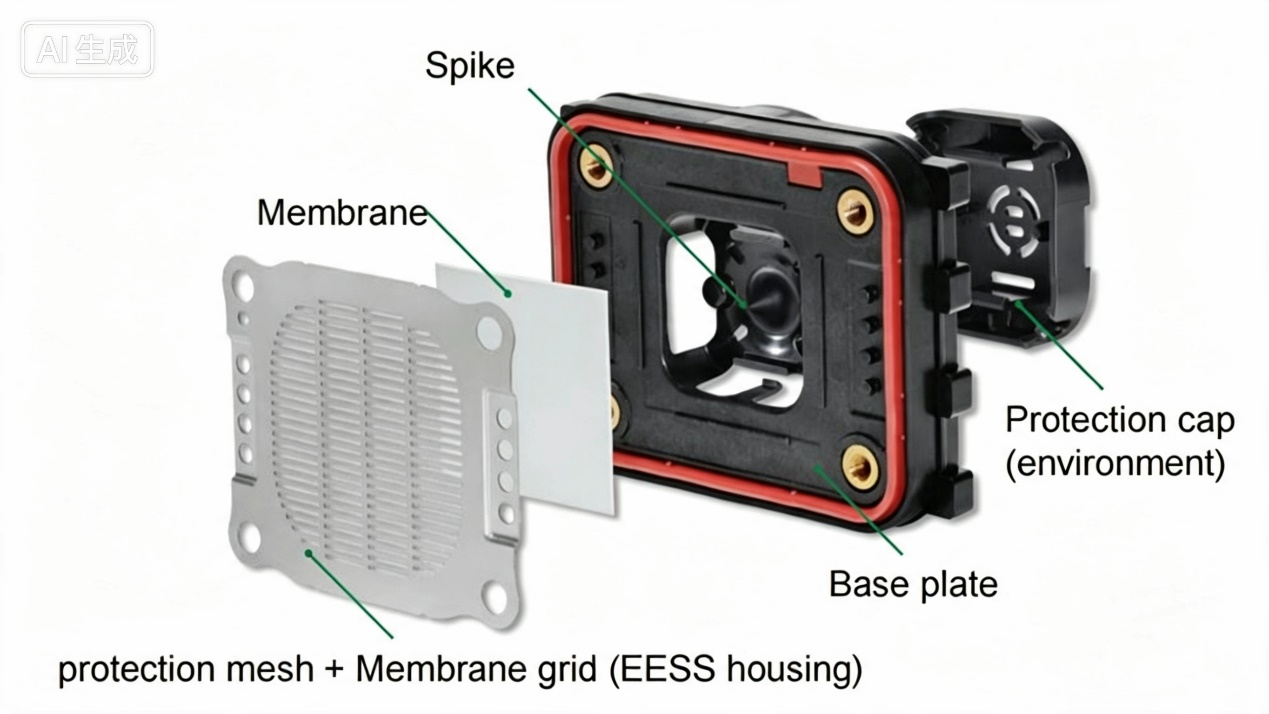
Needle-Type Explosion-Proof Valve
In normal working condition, it functions similarly to a spring-type device. When in explosion-proof mode, the permeable membrane deforms outward under the influence of internal gas pressure. Once the membrane material comes into contact with the built-in pin, it is punctured, allowing direct communication between the battery pack's interior and the outside environment, facilitating rapid gas discharge. The pressure relief process is extremely rapid (<1 second), and the permeability is high. However, after bursting, the permeable membrane is damaged, making it a one-time use product.
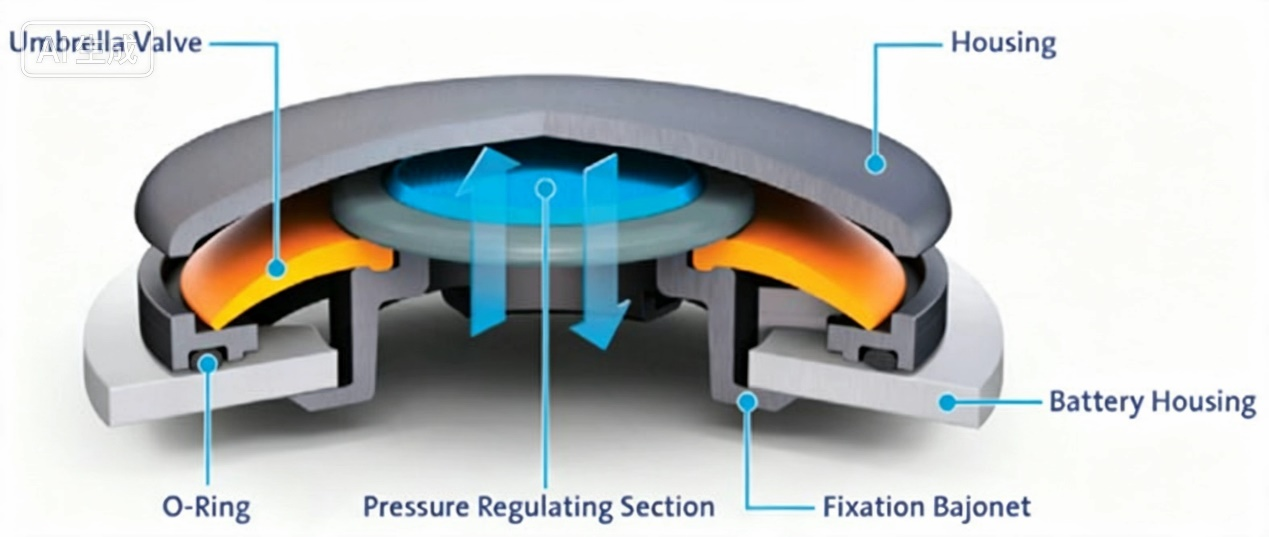
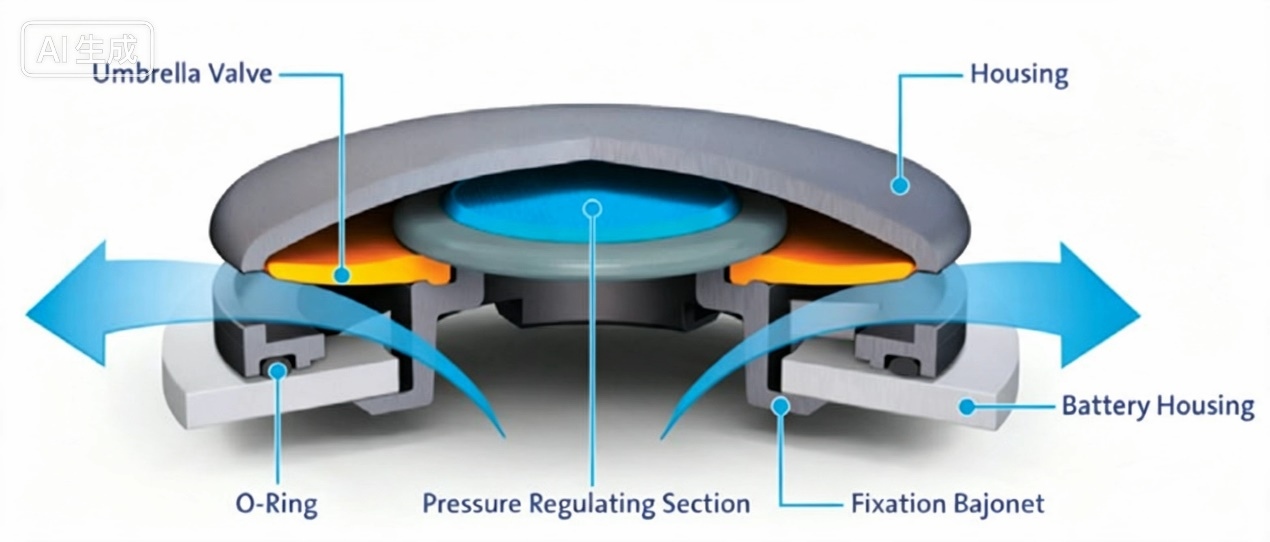
Umbrella Valve Type Explosion-Proof Valve
The umbrella valve type explosion-proof valve features an umbrella-shaped valve resembling a mushroom, with its edges fitting into structural components to achieve sealing and waterproofing. Under normal operation, the explosion-proof valve is closed, relying on a permeable membrane to maintain pressure balance between the inside and outside. When in an explosion-proof state, the edges of the umbrella valve are pushed upward by internal gases, allowing direct communication between the battery pack's interior and the outside environment, facilitating rapid gas discharge. There is another design that separates the functions of explosion prevention and air permeability, featuring a combination of an explosion-proof valve and an air-permeable valve.
2.3 Core Functions of e-PTFE Ventilation Membrane
The normal breathing function of the explosion-proof valve fully relies on the performance of the e-PTFE microporous membrane. Manufactured via stretching processes, the e-PTFE membrane forms billions of micro-pores with pore sizes ranging from 0.1-10 μm. The pores are far smaller than liquid water molecule clusters yet much larger than gas molecules. This unique microporous structure delivers the property of air-permeable yet water-impermeable: gas molecules pass freely through the pores, while liquid water is blocked by surface tension and cannot penetrate the membrane.
Meanwhile, e-PTFE features excellent chemical corrosion resistance, wide high-low temperature tolerance (−200 °C to 260 °C) and anti-aging properties. It maintains stable performance throughout the full service life of power battery packs.
III. Mitigation of Power Battery Failure Risks: Multi-layer Protection Mechanism of Explosion-Proof Valves
3.1 Thermal Runaway Mechanism and Gas Generation Process
Thermal runaway of lithium-ion batteries is a chain reaction, which generally proceeds in the following stages:
- Stage 1 (approx. 90-120 °C): The SEI film decomposes, flammable gas is released, and internal pressure starts to rise.
- Stage 2 (approx. 120-200 °C): The separator melts and shrinks, internal short-circuit aggravates, and electrolyte begins to decompose.
- Stage 3 (above 200 °C): Cathode materials decompose and release oxygen; massive electrolyte decomposition occurs. Gas generation surges sharply, with temperature and pressure climbing exponentially.
- Stage 4: If pressure cannot be released, the housing ruptures. Flammable gas mixes with ambient air, potentially triggering combustion or explosion.
3.2 Multi-layer Protection of Explosion-Proof Valves
Layer 1
Preventive Pressure Equalization
Under normal operating conditions, the explosion-proof valve continuously equalizes pressure difference between the inside and outside of the battery pack enclosure. It prevents cumulative chronic pressure differences induced by temperature fluctuation or altitude variation.
This seemingly simple function is critically important. Sustained internal-external pressure differential accelerates seal aging, degrades enclosure protection rating, and may even cause enclosure deformation or seal failure under extreme temperature differences.
Layer 2
Condensation Suppression and Insulation Protection
Ventilation by the explosion-proof valve effectively suppresses internal condensation. Taking winter operating conditions in Northeast China as an example: when a battery pack moves from a 25 °C garage to a −30 °C outdoor environment, the moisture content inside drops from 0.373 g to 0.005 g. If the 0.368 g moisture difference cannot be vented out, water will condense inside the pack, possibly degrading insulation performance and even causing short circuits. Continuous ventilation of the explosion-proof valve expels moisture and keeps an internal dry environment.
Layer 3
Directional Pressure Relief during Thermal Runaway
This is the most critical safety function of the explosion-proof valve. When thermal runaway occurs and internal pressure reaches the valve opening threshold, the valve opens the pressure-relief channel within milliseconds, discharging high-temperature and high-pressure gas along a pre-defined path. This process achieves three key objectives:
- Preserve enclosure integrity: Keep internal pressure below the housing pressure-resistance limit and avoid housing rupture that would lead to thermal propagation and flame spread.
- Directional discharge: Direct high-temperature gas toward safe directions, away from passenger compartments and critical electrical components.
- Suppress thermal propagation: Rapid pressure relief reduces internal temperature and pressure and slows thermal runaway propagation to adjacent cells.
Post time: Aug-19-2026